Public source review
Dated vendor statements, prices, restrictions and unresolved conflicts. No hands-on claim is implied.
Check this browser’s reported version, platform, screen, language, time zone, WebGL2 and localStorage. Save a baseline, reopen the profile and compare changes. Check Cookie, localStorage and IndexedDB isolation between profiles. Results stay on your device.
Dated vendor statements, prices, restrictions and unresolved conflicts. No hands-on claim is implied.
A manual, local observation of this browser. Product identity is self-reported. Export and compare your own results.
Requires installed versions, a fixed device, proxy configuration and repeated runs. The native Chrome reference has 10 reopen cycles. Vendor-product runs remain pending.
Open this page in the browser you want to examine, then run the check.
Results stay in this tab unless you save a baseline or export them. This check makes no network probes and uploads no test results. Import an export from native Chrome or another profile to compare observations.
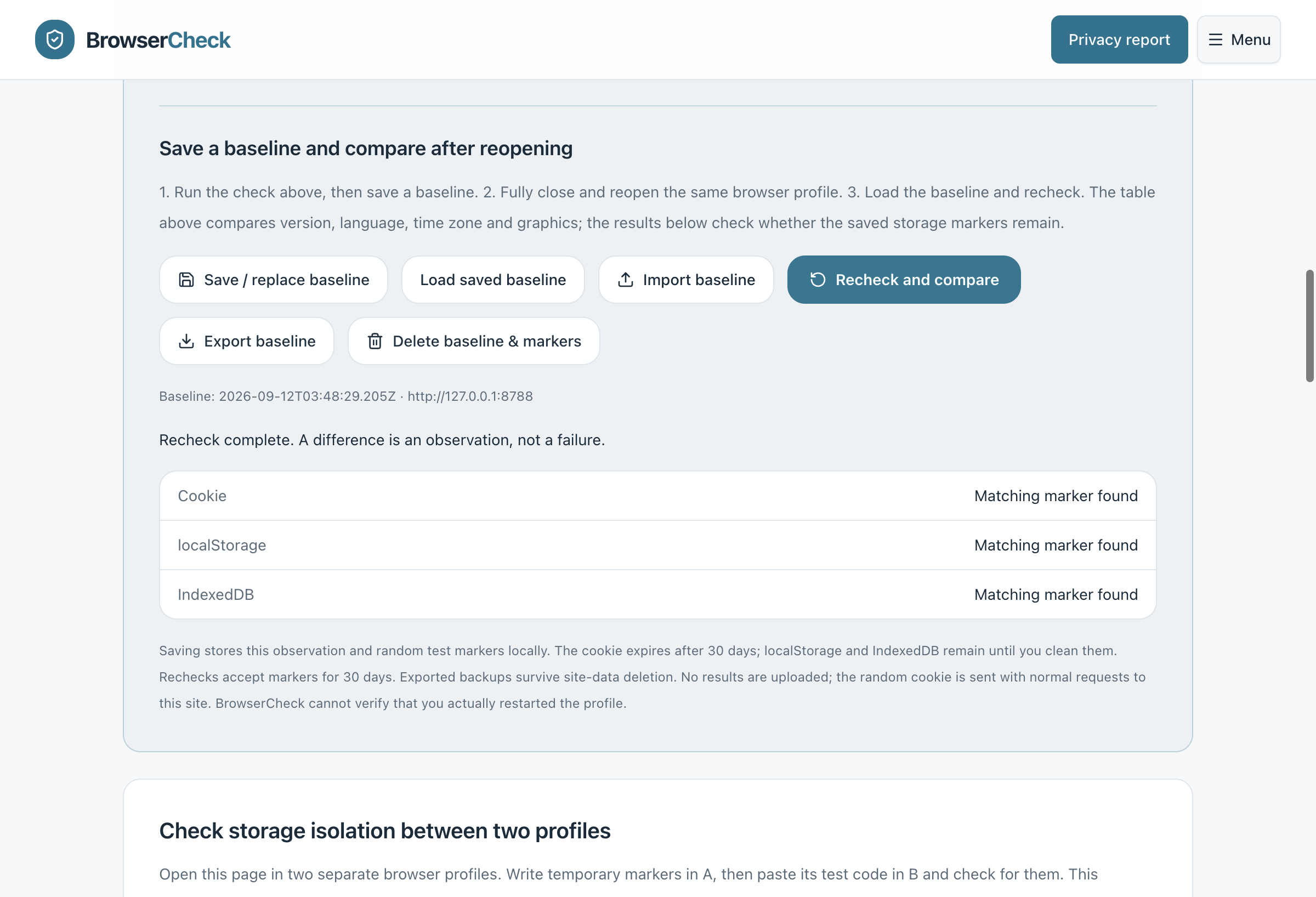
1. Run the check above, then save a baseline. 2. Fully close and reopen the same browser profile. 3. Load the baseline and recheck. The table above compares version, language, time zone and graphics; the results below check whether the saved storage markers remain.
Saving stores this observation and random test markers locally. The cookie expires after 30 days; localStorage and IndexedDB remain until you clean them. Rechecks accept markers for 30 days. Exported backups survive site-data deletion. No results are uploaded; the random cookie is sent with normal requests to this site. BrowserCheck cannot verify that you actually restarted the profile.
Open this page in two separate browser profiles. Write temporary markers in A, then paste its test code in B and check for them. This measures access to BrowserCheck’s own Cookie, localStorage and IndexedDB only. It does not test other websites or prove that accounts cannot be linked.
A matching marker in B means this test data is accessible there: the profiles may share storage, be clones, or be the same profile. An absent marker means only that it was not read; deletion or browser restrictions can also explain it. A failed initial write is inconclusive. Codes are user-provided, not independently verified. Clean each profile with the same code after testing; cleaning B cannot clean a separate A. Cookies expire in 30 days; other markers need manual cleanup. Only this test’s random markers are removed. No test results are uploaded; the random cookie accompanies normal requests to this site.
Chrome 152.0.7977.83 · macOS 26.5.2 · Apple M5 Pro · 48 GiB · 2026-09-12
Two fresh Chrome profiles on one device, with no account or extensions. The test script supplied no proxy or fingerprint overrides. A visible browser window was controlled through CDP and fully closed between runs. BrowserCheck ran from a local production Worker preview; this is a reference for this setup only.
| Measurement | Observed result |
|---|---|
| Unchanged environment values after reopening A | 10/10 |
| Cookie | Retained in A 10/10 · Absent in B 10/10 |
| localStorage | Retained in A 10/10 · Absent in B 10/10 |
| IndexedDB | Retained in A 10/10 · Absent in B 10/10 |
| Cleanup | All test markers absent; unrelated preference retained |
Same-day short sessions on one device do not establish long-term reliability. The page reports a reduced browser version and generic WebGL renderer; full installed version was recorded separately. RAM, CPU, launch duration, browser updates and other websites were not measured.
No installed-product runs have been recorded for these three browsers. Their results, versions and measurements remain unpublished until tests can be run with signed-in clients. The Chrome reference cannot be used to rank them.
This proposed 100-point rubric measures public information quality and documented capabilities, not anti-detection effectiveness. All current products are unassessed. A score will require a published criterion-by-criterion evidence sheet.
Proposed scoring: each criterion receives 0–4 with published anchors and evidence, then contributes weight × rating / 4. Missing or unresolved evidence leaves the overall score unpublished; weights are never silently redistributed.
Protocol outline v2 · September 12, 2026. Baseline rechecks and Cookie / localStorage / IndexedDB checks are available above. The full protocol below includes tests not yet performed.
Record User-Agent, Client Hints, platform, architecture, screen, language and time zone. A difference needs investigation; it is not an automatic failure.
Repeat Canvas, WebGL, WebGL2 and AudioContext observations under the same configuration. Record unavailable or restricted APIs separately.
Run WebRTC and network tests with a documented proxy setup. DNS and TLS require separate instrumentation; a page-only test cannot establish their full behavior.
Write unique disposable markers in cookies, localStorage, sessionStorage, IndexedDB, Cache Storage and Service Workers. Check another profile and clean up afterward.
Create, close, reopen, clone, transfer and update profiles. Repeat 10 and 50 launches, log failures, and distinguish intentional resets from lost state.
Measure launch time, idle CPU and total process-tree RAM at 1, 5 and 10 profiles on one documented device. Use identical pages and report ranges across repeated runs.
Product and browser versions; operating system and hardware; proxy configuration without credentials; test version and date; repeat count; raw observations; failures; untested fields; and the previous result when a version changes. PASS labels need a defined criterion, not a marketing promise.
Platform ban rates, account survival, CAPTCHA bypass and universal detection-bypass claims are excluded. Anonymous community submissions are not enabled; no community run counts or verified-brand statistics are being collected.
Vendor statements are labelled. No paid placement or affiliate tracking links in this directory. No overall detection score is assigned.
A source review is not a hands-on test. Research scores remain unassessed until the rubric is completed.
Read our methodology →